Written by
Cristian Tamas
10
min read
Every thriving support operation has one thing in common: a customer service organizational structure designed around both customer needs and team strengths. The right structure keeps tickets flowing smoothly, agents engaged, and customers coming back.
A well-designed customer service team structure does more than draw reporting lines. It creates clarity around who handles what, how decisions get made, and where customers should turn when they need help. The result: faster resolutions, happier agents, and customers who actually want to come back.
This guide breaks down everything you need to know about structuring your customer service department — from the different organizational models to the specific roles you'll need and the steps to build it all from scratch.
What is a customer service organizational structure?
A customer service organizational structure defines the roles, relationships, and reporting hierarchies within your support team. It maps out who does what, who reports to whom, and who customers should contact for specific issues.
Think of it as the blueprint for your entire support operation. A clear structure ensures every team member understands their responsibilities, managers can allocate resources effectively, and customers experience consistent service regardless of which agent they reach.
Without a defined structure, support teams often struggle with duplicated efforts, unclear escalation paths, and agents unsure of their decision-making authority. These gaps show up in longer resolution times and lower customer satisfaction scores.
Why your customer service organizational structure matters
The way you organize your support team directly affects both your employees and your customers. Here are the key benefits of a well-defined structure.
1. Clear career paths for your team
When your customer service team structure includes defined roles and progression levels, agents can see exactly how to advance. A junior representative knows what skills and performance benchmarks lead to senior status. Senior agents understand the path to team lead or specialist roles.
This visibility keeps talented people around longer. Teams with clear advancement opportunities see higher retention rates because people want to grow where they can see a future.
2. Faster, smarter decision-making
Effective support structures eliminate the "who do I ask?" problem. When your hierarchy clearly defines approval levels — what an agent can decide independently versus what needs a manager — decisions happen faster.
Say a customer requests a refund outside your standard policy window. In a well-structured team, the agent knows immediately whether they can approve it or who to escalate to. No searching for answers, no keeping customers waiting while hunting down a supervisor.
3. Improved collaboration across teams
Customer issues rarely stay in one lane. A shipping delay might involve operations. A product question might need input from engineering. A billing dispute might require finance.
Strong organizational structures build these cross-functional pathways into the framework. Support agents know exactly how to loop in other departments, and those departments understand their role in customer resolution.
4. Accountability without micromanagement
Clear structures let managers delegate confidently. When roles are well-defined, supervisors don't need to hover — they can trust that each team member knows their scope and has the authority to act within it.
This creates space for managers to focus on coaching, strategy, and handling genuine escalations rather than approving routine decisions.
How does organizational structure affect customer service?
Your internal structure shows up in every customer interaction. Here are a few ways your choice of organizational structure shapes your customer service:
1. Customers know exactly where to go
When you clearly communicate your support structure externally, customers stop getting bounced between departments. They know to contact billing for invoice questions, technical support for product issues, and account management for contract changes.
This matters especially for high-value customers. VIP clients with dedicated account managers get direct lines to people who know their history — no starting from scratch with every interaction.
2. Response times drop significantly
Organized teams respond faster because there's no confusion about routing. Tickets automatically flow to the right specialist. Agents aren't wasting time figuring out who should handle an issue.
A tiered functional structure works well here: frontline agents handle common requests while specialists tackle complex technical problems. This keeps simple questions from clogging expert queues and ensures difficult issues reach people equipped to solve them.
AI agents now serve as that frontline tier for many teams. Autonomous AI resolves common inquiries — order status, return policies, sizing questions — instantly and around the clock, while routing complex issues to the right human specialist. Teams using this approach see response times drop by 98% on automated interactions while maintaining high satisfaction scores. If you're wondering when your team is ready to make that shift, these are the prerequisites that successful implementations have in common.
3. Consistency builds trust
Customers notice when their experience varies wildly between interactions. One agent offers a generous resolution while another cites rigid policy. One call takes five minutes while the next takes forty.
Structure creates consistency. When decision-making frameworks, escalation paths, and service standards are documented and followed, customers get reliable experiences that build long-term loyalty.
What are the different types of customer service organizational structures?
Your choice of structure depends on company size, product complexity, customer base, and growth plans. Here are the most common models.
Functional organizational structure
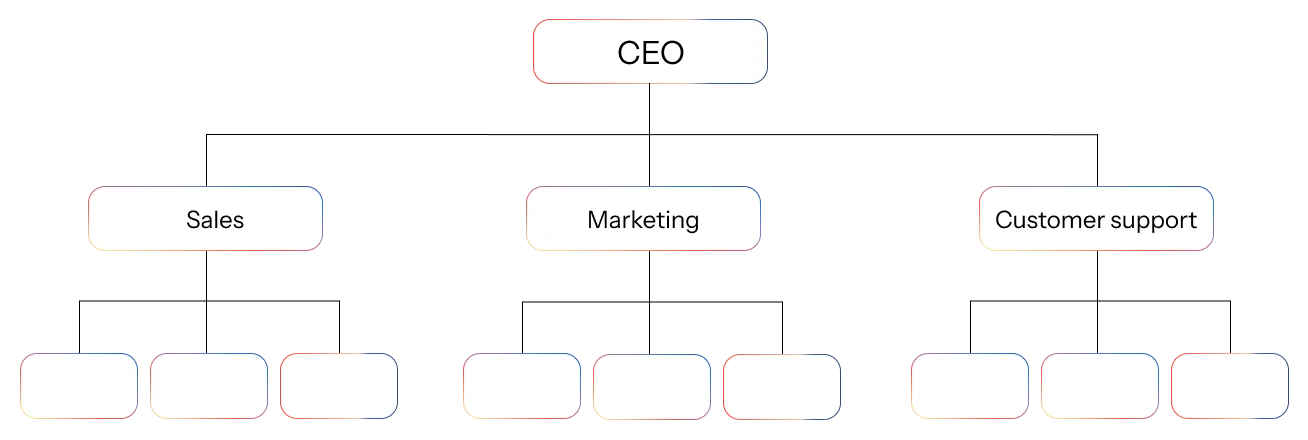
The functional model organizes teams by job type. You have a sales department, a marketing department, and a customer support department — each operating as a distinct unit with its own leadership.
This works well for companies with consistent products and customer bases. Everyone in customer support develops deep expertise in support-specific skills, processes, and tools. New hires train within their function and progress along a clear departmental ladder.
The downside? Functional silos can slow cross-departmental collaboration. When a customer issue requires input from multiple teams, getting everyone aligned takes extra effort.
Product-based divisional structure
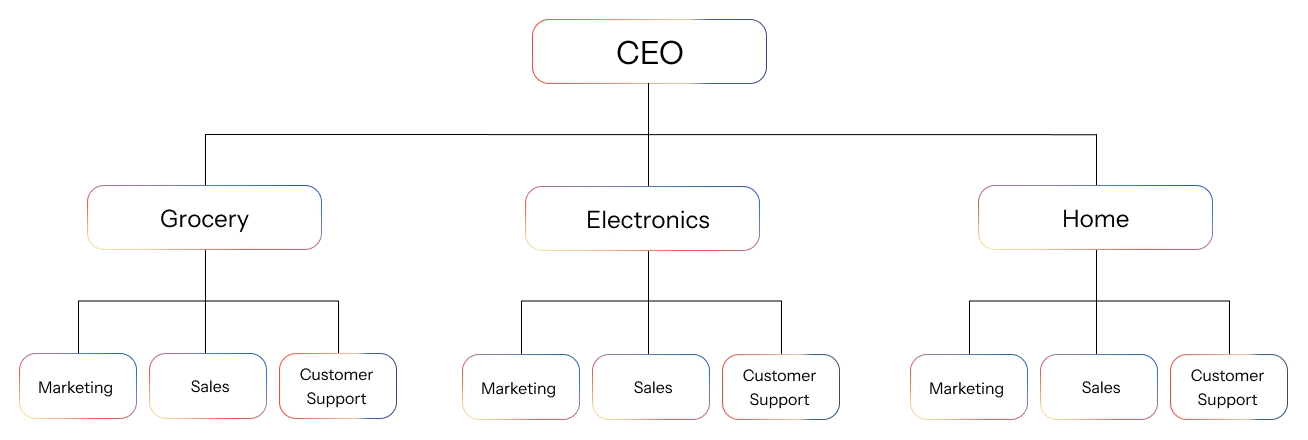
Product-based structures create mini-organizations around each product line. If you sell software, hardware, and consulting services, each division might have its own marketing, sales, and support teams.
Each support team develops expert knowledge of their specific product. Agents understand the nuances, common issues, and customer personas unique to their division.
This structure suits companies with diverse offerings that serve different customer segments. A consumer electronics company might separate support for smartphones, laptops, and smart home devices — each with distinct user bases and technical requirements.
Market-based divisional structure
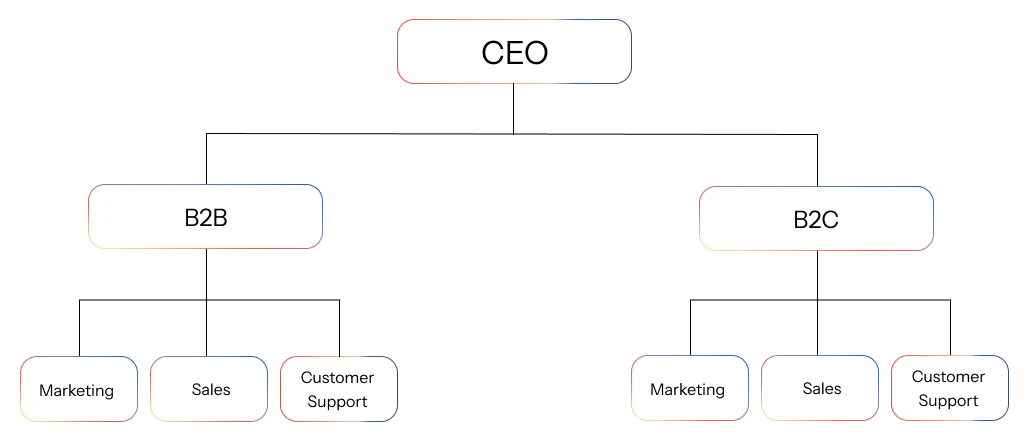
Market-based structures divide by customer segment rather than product. A B2B team handles enterprise accounts while a B2C team serves individual consumers. Each has dedicated marketing, sales, and support functions tailored to their market's needs.
B2B customers often require longer relationships, account management, and complex contract support. B2C customers typically need quick resolutions and self-service options. Separate structures let each team optimize for their audience.
Geographic divisional structure
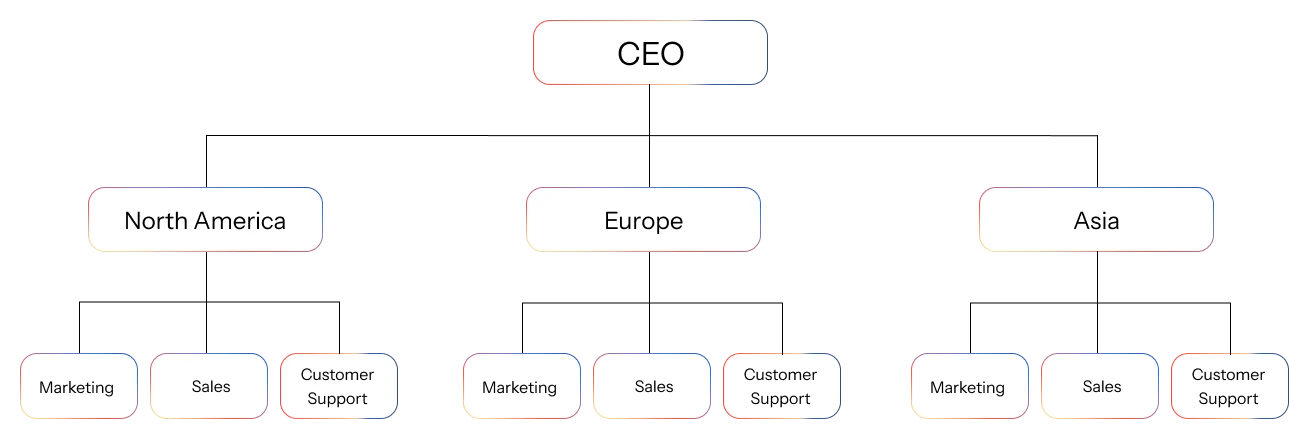
Global companies often organize by region: North America, Europe, Asia-Pacific. Each region operates somewhat independently with local support teams that understand regional languages, cultures, and time zones.
This ensures customers reach agents during reasonable hours and speak with people who understand local context. Your German customers get support from agents who speak fluent German and know EU regulations.
The challenge is maintaining consistency across regions. Clear global standards prevent customers from receiving wildly different experiences depending on where they're located.
Process-based structure
Process-based structures organize teams by stages in the customer journey rather than job function. You might have distinct teams for onboarding new customers, ongoing daily support, technical troubleshooting, and retention.
This approach works well for SaaS companies with complex products. The onboarding team specializes in getting customers up and running. The technical team handles advanced troubleshooting. The retention team focuses on at-risk accounts.
Each team develops deep expertise in their stage of the journey, leading to smoother handoffs and specialized skill development.
Matrix organizational structure
Matrix structures blend multiple models. An agent might report to both a functional manager (Head of Support) and a project or product manager. This creates flexibility but requires clear communication about priorities.
You might use matrix structures when support agents need to work closely with product teams on specific initiatives while maintaining their core support responsibilities.
Flat organizational structure
Flat structures minimize hierarchy. Instead of multiple management layers, you have a small leadership team and empowered frontline agents with broad decision-making authority.
Startups often operate this way out of necessity — there simply aren't enough people for layers. But some larger companies intentionally stay flat to encourage ownership and speed.
The tradeoff is that flat structures make scaling harder. Without clear career progression, retaining ambitious team members becomes challenging.
How do you build a customer service organizational structure?
Ready to define or refine your support structure? Follow these steps to build something that actually works.
1. Pick the right model for your business
Your structure should match your business reality. Consider these factors when selecting a model:
Your company size: Smaller teams often start functional and add complexity as they grow. If you're planning rapid expansion, build a structure that can scale without complete redesign.
Geographic footprint: Serving customers across multiple time zones or countries? Geographic elements in your structure ensure coverage and cultural fit.
Product complexity: Multiple distinct products with different customer bases suggest product-based divisions. A single product serving diverse segments might benefit from market-based organization.
Customer expectations: If your customers expect 24/7 support, your structure needs to enable round-the-clock coverage. If they expect dedicated account managers, build that into the design.
2. Define roles and responsibilities
Once you've chosen a model, map out the specific roles you need. Common positions in customer service teams include:
Customer Service Manager: Leads the team, sets strategy, manages budgets, and reports to executive leadership. Responsible for overall performance and team development.
Team Lead or Supervisor: Manages a subset of agents, handles escalations, coaches team members, and ensures quality standards. Often the first step into management.
Customer Service Representative: Frontline agents handling direct customer interactions via chat, email, or phone. Responsible for resolving issues within their authority and escalating appropriately.
Technical Support Specialist: Handles complex technical issues requiring deeper product knowledge. Often works with engineering teams on bug reports and feature requests.
Account Manager: Owns relationships with high-value or enterprise customers. Focuses on retention, expansion, and strategic partnership rather than ticket resolution.
When placing people in these roles, consider what drives them. Some agents thrive on variety and fast-paced ticket resolution. Others prefer deep-dive technical troubleshooting. Match roles to strengths and motivations.
3. Establish clear decision-making processes
Structure without decision rights creates bottlenecks. Define what each role can decide independently and what requires approval.
Frontline agents might have authority to issue refunds up to a certain amount, extend trial periods, or waive fees for loyal customers. Larger concessions might require team lead approval. Policy exceptions might need manager sign-off.
Document these guidelines clearly. When agents know their decision-making boundaries, they act confidently — and customers get faster answers.
4. Build effective communication channels
Your structure determines how information flows. Design channels that match your hierarchy while enabling cross-functional collaboration.
Internal channels might include:
Team chat for quick questions
Ticketing systems for customer issues that need input from other departments
Regular team meetings for updates and training
External communication requires equal thought. Customers need to know how to reach the right team. Clear documentation, intuitive contact forms, and smart routing reduce friction for customers and agents alike.
5. Measure what matters
You can't improve what you don't measure. Establish KPIs that align with your structure and goals:
Response time and resolution time: Track how quickly customers get initial responses and final resolutions. Break these down by tier, channel, and team to identify bottlenecks.
Customer satisfaction (CSAT): Survey customers after interactions to gauge experience quality. Compare scores across teams and individual agents.
First contact resolution: What percentage of issues get resolved in a single interaction? Higher rates indicate effective routing and agent empowerment.
Agent utilization and workload: Ensure work distributes evenly across your structure. Overloaded teams signal capacity or structural issues.
The challenge is surfacing patterns across thousands of interactions. What are customers actually frustrated about? Which issues keep recurring? What language do they use when they're about to churn?
AI customer intelligence tools can analyze every conversation — not just the sample your QA team reviews — and surface trends that would otherwise stay buried. This turns your support interactions into a real-time feedback loop for product, marketing, and operations.
Regular review of these metrics reveals whether your structure is working — and where adjustments might help.
Building your support team for long-term success
Your customer service organizational structure isn't a one-time decision. As your company grows, products evolve, and customer expectations shift, your structure should adapt.
Review your org design at least annually. Are escalation paths still logical? Do role definitions reflect current responsibilities? Have you added products or markets that need dedicated support?
The best structures balance stability with flexibility. They give teams clear direction while leaving room to respond to change.
How AI reshapes your organizational structure
AI doesn't fit into your org chart as a team member — it changes how you design the structure itself.
Tier distribution shifts. When autonomous AI resolves 50-80% of incoming volume (order status, returns, FAQs, subscription changes), you need fewer generalist agents handling routine requests. That frees budget to invest in specialists, technical support, and account managers who handle the work that actually requires human judgment.
Role definitions evolve. "Customer Service Representative" means something different when AI handles the repetitive inquiries. Human agents focus on complex issues, angry customers who need emotional intelligence, and situations that require creative problem-solving. The job becomes more challenging — and more rewarding.
Coverage changes. Traditional structures require geographic teams or shift rotations to provide 24/7 support. AI handles off-hours volume instantly, which means you can structure your human team around peak hours and complex issue types rather than timezone coverage.
Escalation paths simplify. Instead of tier-1 → tier-2 → specialist routing, AI handles the frontline and routes directly to the right human based on issue type and complexity. Fewer handoffs, faster resolution.
Quality assurance scales. Siena's QA Agent can review 100% of interactions, not just the sample your QA team manually checks. This changes how quality assurance fits into your structure, shifting from spot-checking to pattern recognition across every conversation.
Curious how AI can reshape your support structure? Talk to our team to see Siena in action.
Frequently asked questions
What is a customer service organizational structure?
A customer service organizational structure defines how support teams are organized, including roles, reporting relationships, and workflows. It establishes who handles what types of issues, how escalations work, and who makes which decisions. A clear structure helps teams operate efficiently and deliver consistent customer experiences.
How does AI affect customer service team structures?
AI reshapes how you design your structure rather than fitting into it as a team member. When AI handles 50-80% of routine volume, you need fewer generalist agents and can invest more in specialists and account managers. Escalation paths simplify — AI routes directly to the right human based on issue type. Coverage becomes easier since AI handles off-hours instantly, reducing the need for geographic teams or shift rotations built around timezone coverage. That's how a single team ended up covering every time zone without adding headcount.
What are the most common types of customer service team structures?
The most common structures include functional (organized by job type), product-based divisional (organized by product line), market-based divisional (organized by customer segment like B2B vs B2C), geographic (organized by region), and matrix (combining multiple approaches). The right choice depends on your company size, products, and customer base.
How does organizational structure affect customer service quality?
Structure directly affects response times, consistency, and resolution rates. Clear hierarchies ensure tickets reach the right agents quickly. Defined decision-making authority lets agents resolve issues without delays. Well-designed escalation paths prevent customers from getting bounced between departments. Poor structure leads to longer wait times and inconsistent experiences.
What roles should a customer service team include?
Core roles typically include Customer Service Manager (strategy and leadership), Team Leads (frontline management and escalations), Customer Service Representatives (direct customer interactions), Technical Support Specialists (complex technical issues), and Account Managers (relationship management for key accounts). Specific roles depend on your team size and customer needs.
How do you choose the right organizational structure?
Consider your company size, geographic footprint, product complexity, and customer expectations. Smaller teams often start with simple functional structures and add complexity as they grow. Companies with multiple distinct products may benefit from product-based divisions. Global companies often need geographic elements to ensure coverage and cultural fit.
How often should you review your customer service structure?
Review your structure at least annually, or whenever significant changes occur — like launching new products, entering new markets, or experiencing rapid growth. Signs you need restructuring include persistent bottlenecks, unclear escalation paths, uneven workload distribution, or declining customer satisfaction scores.